

MOUNT TOLMIE COMMUNITY ASSOCIATION
Society Incorporation # S0033986
CONSTITUTION & BYLAWS
Last Revised: December 7, 2024, Saanich, BC
CONSTITUTION
- The name of the Association is “Mount Tolmie Community Association” (hereafter MTCA).
- The purpose of the Association is: a) To facilitate, promote, support or undertake activities
that will enhance the quality of life for those living and working in the Mount Tolmie area.
b) To foster community engagement, and act as a liaison between the residents of the
community and all levels of government, local businesses, commercial property
managers/owners and other non-profit organizations.
BYLAWS
Part 1. Definitions and Interpretation
1.1 In these Bylaws, unless the context otherwise requires:
"Act" means the Societies Act of British Columbia and the regulations made under it;
“Association” means the Mount Tolmie Community Association;
“Board” means the directors of the Association;
“Bylaws” means these bylaws as altered from time to time;
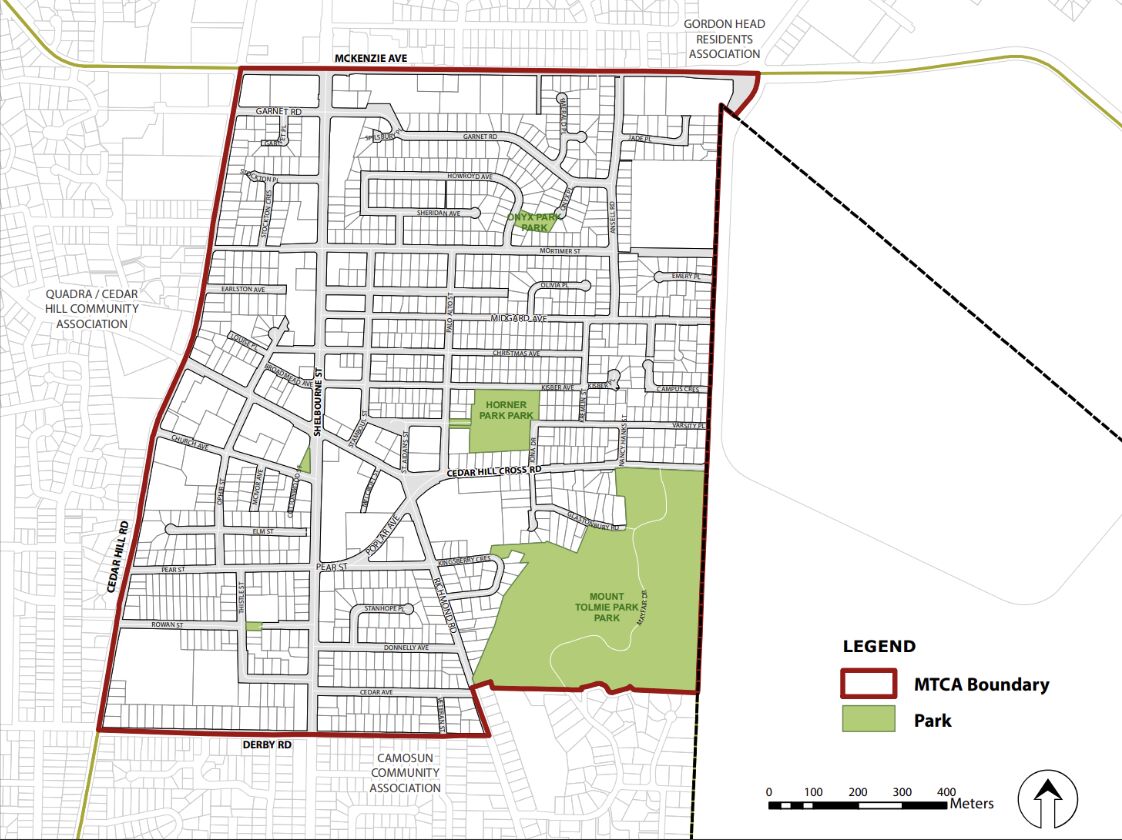
“MTCA Boundary Area” means the geographic area within the municipality of Saanich,
as set out in the map in Appendix A;
"special resolution" means a resolution passed by a two-thirds majority of Members
present at a general meeting, provided that proper notice has been given in advance of
the meeting specifying the intention to propose the resolution as a special resolution.
1.2 The definitions provided in the Act apply to these Bylaws.
1.3 If there is a conflict between these Bylaws and the Act (as amended from time to time) or
the regulations under the Act, the Act or the regulations prevails.
Part 2. Activities
2.1 The Association will strive to achieve its stated purpose by promoting, facilitating,
supporting, or undertaking activities that will enhance the quality of life of the Mount
Tolmie community including, but not limited to, the following:
a) Reviewing and providing feedback on all proposals for property development and
changes in land use in the MTCA Boundary Area and adjacent areas;
b) Encourage the District of Saanich conducts meaningful and effective consultation
with the community concerning all public projects within the MTCA Boundary Area,
as well as any changes in public policy that affect residents;
c) Facilitating communication between community residents and other agencies,
including schools, other community associations, and developers;
d) Providing residents with accurate and relevant information on matters related to
physical, environmental, economic, development, social, aesthetic and
transportation issues that impact the community;
e) Supporting and nurturing initiatives by individuals, neighbourhoods, community
associations or residential areas that align with the Association’s purposes;
f) Promoting safety and emergency preparedness for the community’s residents; and,
g) Raising funds and securing grants as necessary to further the Association’s
objectives.
2.2 The Association shall not support, endorse, or affiliate with any political party or
candidate for public office. However, the Association mya take positions on public policy
matters or advocate for issues that align with its purposes, provided such advocacy
remains non-partisan and is not used to benefit or promote any specific political party or candidate.
Part 3. Membership
3.1 Application: Membership is obtained by submitting an application to the Association and
paying the current membership fees. A person, household, business, or organization
becomes a Member upon the Association’s acceptance of the application. A household,
business or organization that is a Member must designate one individual to serve as its
voting representative.
3.2 Eligibility: Members must either reside, own property, or have their registered place of
business within the MTCA Boundary Area as outlined in Appendix A. Membership will
terminate when these conditions are no longer met.
3.3 Fees: Membership fees shall be set on an annual basis and determined by the Board.
3.4 Standing: A Member is considered not in good standing if they fail to pay the annual
membership fees. Members who are not in good standing may not vote at any meetings
of Members or Directors. The Member will remain in this status until all outstanding dues
are paid in full.
3.5 Responsibilities: Members are responsible for keeping their contact information,
including their address and email address, up-to-date with the Association. All Members
shall abide by the Constitution and Bylaws of the Association.
3.6 Termination: A person ceases to be a Member of the Association under the following
conditions:
a) By submitting a written resignation or informing the Association they no longer meet
the residency or business location requirements of the MTCA Boundary Area;
b) If they are found by the Board to be in violation of the Constitution or Bylaws;
c) Upon their death; or,
d) By remaining a Member not in good standing for a period of 12 consecutive months.
3.7 Expulsion: A Member may be expelled from the Association by a two-thirds vote of the Board for actions deemed prejudicial to the purpose or activities of the Association.
Part 4. Annual General Meeting and other General Meetings of Members
4.1 Location: General meetings of Members of the Association, including the Annual General
Meeting (“AGM”), will be held at a location in Saanich determined by the Board and/or by
videoconference, with the date and time also set by the Board.
4.2 Frequency: An AGM must be held annually and no later than March 31 after the fiscal
year-end.
4.3 Ordinary Business: At a general meeting, the following items constitute ordinary
business:
a) Adoption of any rules of order;
b) Consideration of the financial statements of the Association presented at the
meeting, along with any reports from the Directors or auditor;
c) Election of Directors and setting of the first Directors meeting post AGM;
d) Appointment of an auditor, or waiver thereof; and,
e) Consideration of any business arising from Directors’ reports that does not require
the passing of a special resolution.
4.4 Notice: The notice of a general meeting must detail any business, other than ordinary
business, to be transacted, and must provide sufficient information to allow Members to
form a reasoned judgment on the nature of that business. For the purposes of the Act,
notice of a general meeting is deemed to be properly given if:
a) It is sent by email to each Member who has provided an email address to the
Association; and,
b) It is posted on the Association’s website, accessible to all Members, at least 14 days
prior to the meeting, and remains posted until the date of the meeting.
The failure of any Member to receive notice does not invalidate proceedings of the
meeting.
4.5 Chair: A person appointed by the Board will preside as the chair of a general meeting. If
the Board does not appoint a chair or if the appointed chair is unable to act, the following
individuals will preside as chair:
a) The President
b) If the President is unable to preside, the Vice President; or,
c) If neither the President nor the Vice President is available, one of the Directors
present at the meeting, as determined by the Directors.
4.6 Alternate Chair: If no Director is available to preside as chair within 15 minutes of the
scheduled start time, the Members present shall elect a Member in attendance to preside
as chair.
4.7 Quorum: No business, other than the election of a chair and the adjournment or
termination of the meeting, shall be conducted at a general meeting unless a quorum of
Members is present. A quorum is defined as the lesser of 20 Members or 10% of the
membership.
4.8 Adjournment and subsequent quorum: If a quorum is not present at an AGM, the AGM
will be adjourned to the same day, time, and place in the following week. If quorum is still
not met within 30 minutes of the start time at the rescheduled meeting, the Members
present will constitute a quorum for that meeting.
4.9 Agenda: The order of business at a general meeting is as follows:
a) If necessary, elect a Member to chair the meeting;
b) Confirm that a quorum is present;
c) Approve the agenda;
d) Approve the minutes of the previous general meeting;
e) Address any unfinished business from the previous general meeting;
f) If the meeting is an AGM:
i. Receive the Treasurer’s report and the Association’s financial statements for
the previous fiscal year, and if required, the auditor’s report;
ii. Receive reports on the activities and decisions of the Directors since the last
AGM;
iii. Elect Directors;
iv. Setting the date of the first Director’s meeting post AGM; and,
v. Appoint an auditor, if necessary;
g) Address new business, including matters for which notice has been given to the
Members; and,
h) Conclude the meeting.
4.10 Voting Eligibility: All current paid Members are entitled to one vote at any general
meeting provided they have been a paid member for at least 14 days prior to the
meeting.
4.11 Voting Method: Voting must be conducted in person or by video conference, by a
physical show of hands or equivalent electronic method approved by the meeting chair.
Proxy or absentee voting is not permitted.
4.12 Voting Decision: All voting at meetings (AGMs or other general meetings) shall be
decided by a simple majority vote, unless the Act or these Bylaws require a special
resolution, which has a higher voting threshold. The chair does not have a tie-breaking
vote, and in the event of a tie, the motion is defeated.
4.13 Voting Outcome: The chair of a general meeting must announce the outcome of each
vote, and that outcome must be recorded in the meeting minutes.
4.14 Amendments: The Constitution and Bylaws may be amended by special resolution.
Part 5. Board of Directors
5.1 Composition: The affairs of the Association shall be managed by a Board of Directors,
consisting of no fewer than 5 and no more than 9 Members.
5.2 Nominations: The Board of Directors shall serve as the Nominating Committee for new
Directors. Nominations for Board positions must be submitted in writing to the Board.
5.3 Consent to Act: Prior to the time of their election or appointment, or at the meeting at
which they are elected or appointed, all Directors must provide a written declaration
stating that they:
a) Are willing to serve as a Director;
b) Are qualified to serve as a Director under the Societies Act; and,
c) Agree to abide by the Constitution, Bylaws, and any Code of Conduct of the
Association.
5.4 Eligibility: At the time of their election and throughout their term, all Directors must be
voting Members of the Association in good standing, having paid their annual
membership fee.
5.5 Election of Directors: At each AGM, voting Members shall elect or appoint the Board of
Directors.
5.6 Term: Each Director will serve a 1-year term, beginning from one AGM and ending at the
next AGM. Serving part of a term is considered equivalent to a full term and is counted
consecutively with any previous or subsequent terms.
5.7 Re-election: Directors are eligible for re-election up to the term limit set in Bylaw 5.8.
5.8 Term Limit: No individual may serve more than 6 consecutive 1-year terms on the Board.
Once a Director has reached this limit, they are ineligible to serve on the Board again until
at least 2 years have passed. After this break, they are once again eligible to be elected as
a Director.
5.9 Participation: All Directors are expected to actively participate in the business and
activities of the Association.
5.10 Reporting: Any Director conducting business on behalf of the Association must report their activities to the Board.
5.11 Duties: Directors are required to act honestly, in good faith, and in the best interests of
the Association.
5.12 Direct Appointments: The Board of Directors, by a two-thirds (2/3) majority vote, may
appoint a Member in good standing to fill a vacancy on the Board and in particular to add
a Director with specific expertise, experience, or skills deemed beneficial to the
Association.
5.13 Resignation or Removal: A Director may resign by notice in writing to the President or
Vice President. A Director is deemed to have resigned upon ceasing to be a Member of
the Association or as set forth in Bylaw 7.10. A Director may be removed from office by a
special resolution passed at a general or special meeting of Members of the Association,
and may simultaneously elect a Director to fill the vacancy.
Part 6. Board Officers
6.1 Election of Officers: At the first meeting of the Board of Directors following each AGM,
the Directors shall elect from among themselves the following Officers: President, Vice
President, Treasurer, and Secretary. Each Officer term will last until the next AGM.
6.2 Multiple Roles: With the exception of the President and Vice President, a Director may
be elected to hold more than one Officer position.
6.3 Duties: The specific duties of each Officer are outlined in Appendix B – Officer Duties.
6.4 Term Limit: The President, Vice President, and Treasurer may not serve in their
respective offices for more than 3 years.
6.5 Resignation or Removal of Officers: A Director may resign as an Officer by written notice
to the Chair. An Officer may be removed by a two-thirds (2/3) majority vote of the Board
of Directors. After any resignation or removal of an Officer, the Board of Directors must
elect a Director to replace that Officer position at the earlier of a regular or special Board
meeting.
Part 7. Board of Directors Meetings
7.1 Purpose: The purpose of the Board of Director Meetings is to:
a) Provide leadership and governance for the Association;
b) Oversee the management of the Association’s affairs and resources;
c) Establish and review policies and procedures;
d) Make decisions on matters affecting the Association and its members;
e) Ensure compliance with the Bylaws and applicable laws; and,
f) Advance the purpose, mission, activities and objectives of the Association for the
benefit of the community.
7.2 Regular Board meetings: Six (6) regular Board meetings shall be held each year,
approximately every 2 months, according to a schedule determined at the Board meeting
immediately following the AGM. The Board of Directors, by a two-thirds (2/3) majority
vote, may change the date and time of any regularly scheduled meeting.
7.3 Special Meetings: Board meetings other than regularly scheduled Board meetings may
be called by the President, the Vice President, or any 2 Directors acting together.
7.4 Member access: Board meetings shall be open to all paid Members of the Association;
however, these Members are not entitled to participate in any voting that occurs during
the meeting.
7.5 Subcommittees: The Board may appoint volunteer Members or establish subcommittees
as needed to work on specific projects. Each subcommittee must be chaired by a Director
but may include other Members of the Association or the broader community. All
proceedings of the subcommittees must be reported to the Board, and any
recommendations made must be ratified by the Board. Subcommittee members are not
required to reside within the MTCA Boundary Area.
7.6 Notice: Reasonable notice of a special Board meeting, along with a proposed agenda,
must be provided to all Directors, unless all Directors agree to a shorter notice period.
The accidental omission to give notice of a Board meeting to a Director, or the non-
receipt of such notice by a Director, does not invalidate any proceedings at the meeting.
7.7 Quorum: A quorum for Board meetings shall consist of a majority (above 50%) of the
Directors then in office.
7.8 Record Keeping: If the Records Secretary is absent from a meeting, the Board must
appoint another individual to act as Records Secretary for that meeting.
7.9 Decision-Making: At all meetings of the Board of Directors, decisions on all matters shall
be made by a show of hands, in person or by video conference. The chair shall announce
the outcome of every vote, and that decision shall be recorded in the minutes of the
meeting. Each Director shall have only one vote in Board decisions.
7.10 Required Attendance: Any Director who fails to attend 3 regular Board meetings, either
consecutively or during a calendar year, will be deemed to have resigned and will
immediately cease to be a Director, unless otherwise determined by the Directors.
7.11 In-Camera Sessions: In exceptional circumstances, the Board may hold meetings or
portions of meetings in-camera without Members present. An in-camera session requires
the approval of two-thirds (2/3) of the Directors present before the session can begin. All
Directors are required to keep information discussed during an in-camera session
confidential, unless the release of such information is required by law or permitted by a
Board decision or policy.
Part 8. Conflict of Interest Procedures for Directors
8.1 Scope: This section applies to any Director who has a direct or indirect material interest
in a contract, transaction, or proposed contract or transaction involving the Association,
or in any matter under consideration by the Board, if that interest creates or could create
a conflict with the Director's duty or interest as a Director of the Association.
8.2 Disclosure Requirements: A Director to whom this Part applies must:
a) Fully and promptly disclose the nature and extent of their interest to the other
Directors;
b) Abstain from voting on any resolution or decision regarding the contract, transaction,
or matter;
c) Leave the meeting while the issue is discussed and voted upon; and,
d) Refrain from any action intended to influence the discussion or the vote.
8.3 Conflict Concerns: If any Director believes that another Director may have a direct or
indirect conflict of interest, this concern must be raised with the Board before any
discussion or vote on the matter takes place.
8.4 Conflict Determination: The Board will decide by majority vote whether a conflict of
interest exists, based on the definitions in the Societies Act. The Director in question is
not permitted to vote on whether a conflict of interest exists regarding their own
situation.
Part 9. Finance and Operational Matters
9.1 Fiscal Year: The fiscal year of the Association shall follow the calendar year, from January
1st to December 31st.
9.2 Funds Management: The funds of the Association shall be maintained in a public
financial institution.
9.3 Signing Authority: At least 2 Directors must sign or authorize any transfer of funds of the
Association by cheque, e-transfer, or other method. For any other legal document
binding the Association, a majority of Directors shall sign (using Docusign or other secure
electronic method is permitted).
9.4 No Remuneration: No Director or Member shall receive direct remuneration for services
rendered to or for the Association, except for the reimbursement of business expenses.
9.5 Expenditure Approval: Any expenditure exceeding $1,000 must receive approval from
the Board.
9.6 Financial Reporting: The financial accounts of the Association must be reported at each
AGM.
9.7 Prohibited Actions: The Association shall not borrow money, issue bonds, lend money,
or mortgage, charge, or offer other security on its property or assets.
9.8 No Indebtedness: The Association shall not incur any indebtedness, except for the
purchase of goods and services necessary to carry out the Association’s purposes, which must be paid for within 2 months of receipt.
9.9 Meeting Conduct: Unless otherwise stated in these Bylaws, all meetings shall be
conducted in accordance with the most current edition of Robert’s Rules of Order Newly
Revised.
Part 10. MTCA Association Area
10.1 The Association’s area of jurisdiction is as defined in the attached map, Appendix A:
“MTCA Association Boundary Map”.
APPENDIX A) MTCA Association Boundary Map
APPENDIX B) Officer Duties
President:
Presides as chair at all meetings of the Association and the Board of Directors.
Acts as the chief executive officer of the Association and supervises the other Officers in the
execution of their duties, providing overall leadership.
Organizes meeting agendas in consultation with other Officers or delegates this responsibility to
another Director.
Ensures that the Association meets regularly, at a minimum of every 2 months.
Acts as the official representative of the Association and handles its correspondence.
May task Directors to represent the Association for specific events or purposes.
Is one of the authorized signatories for the Association's bank account.
Vice President:
Assists the President in their duties.
In the absence of the President, chairs meetings and assumes the President’s duties.
Ensures the Association meets regularly, at a minimum of every 2 months.
Is one of the authorized signatories for the Association's bank account.
Treasurer:
Maintains a bank account in the name of the Association, keeps a record of authorized
signatories, and receives regular bank statements either in print or electronically.
Keeps full and accurate accounts of all receipts and disbursements and deposits all funds into
the Association’s bank account.
Disburses funds as authorized by a vote of the Board and in accordance with these Bylaws. The
Treasurer will render an account of all financial transactions and the financial position of the
Association whenever required by the Board.
Maintains accurate and current records of all funds received and spent, including a balance
sheet for the Association.
Keeps all necessary financial records to comply with the Societies Act.
Presents a financial report at the Annual General Meeting.
Is responsible for applying for annual grants from the Municipality of Saanich or other
organizations.
Maintains any insurance policies held by the Association.
Files any reports or taxes required by law or policy.
In the absence of an auditor, makes financial records and banking information available for
examination by the Directors no less than ten days before the AGM.
In coordination with the Secretary, maintains a register of Members.
Is one of the authorized signatories for the Association's bank account.
Secretary:
Keeps records of minutes and correspondence for the Association.
Maintains the records of the Association in accordance with the Societies Act.
Issues notices of AGMs, general meetings of Members, and Board of Directors meetings.
Files the annual report and any other required filings with the registrar under the Societies Act.
In the Secretary's absence, appoints another Director to act as secretary during meetings.
In coordination with the Treasurer, maintains a register of Members.
Is one of the authorized signatories for the Association's bank account.
Receives regular bank statements either in print or electronically.
Non-Officer Directors-at-large:
May call and chair meetings in the absence of the President or Vice President, in accordance
with the Bylaws.
Actively participate in the Association’s activities and may take on responsibilities or represent
the Association on subcommittees or in specific volunteer roles assigned by the Board or
President.
May be assigned as the Association’s Webmaster, updating the Association’s website and
communications.
Outgoing Officers:
Expected to assist in the transition to the new officer.